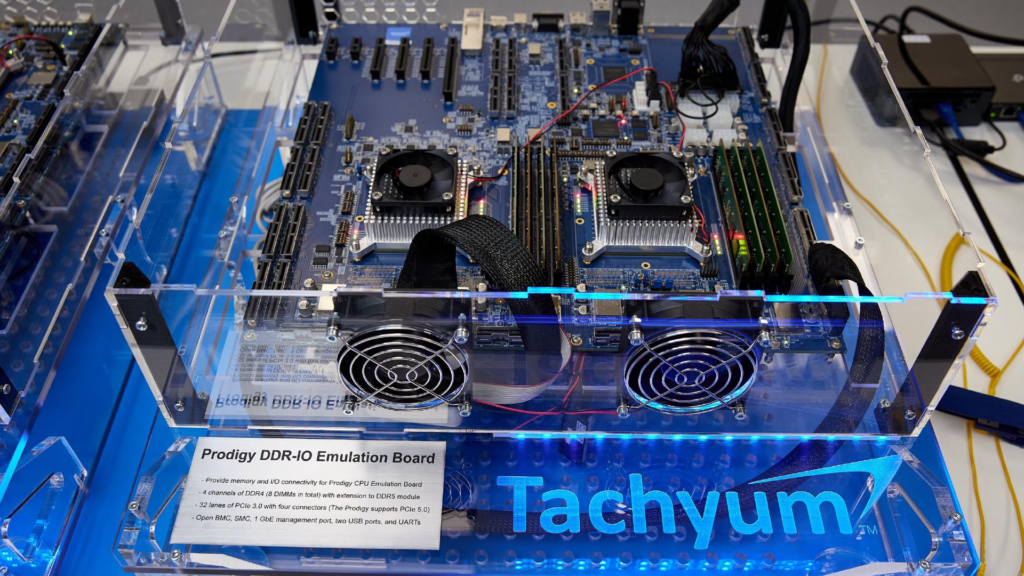
Update 11/2/2026 3:00 PM ET: As it turns out, the ultimate parent company and holder of all Tachyum intellectual property is Cayman Islands-based Tachyum Ltd., which controls U.S.-based Tachyum Inc., which in turn controls Slovakia-based Tachyum s.r.o. that is responsible for the lion’s share of Tachyum’s development of the Prodigy universal processor. This means that while Tachyum Inc. and Tachyum s.r.o. can be declared insolvent and liquidated, Tachyum Ltd. can continue operations, establish new entities and continue developing Prodigy.
However, the Cayman Islands company holding Prodigy-related patents is itself the target of liquidation proceedings. Therefore, the Slovak subsidiary’s bankruptcy cannot necessarily protect Prodigy’s intellectual property from creditors. If Tachyum Ltd. is liquidated, the control over the Prodigy patents could pass to court-appointed liquidators, who could sell them to repay creditors. While the current Tachyum management could buy Prodigy’s patents back cheaply, they would have to compete with other interested buyers and satisfy the applicable sale requirements. In any case, this could be the end of the road for Tachyum.
Tachyum, the company behind the overpromised and overhyped universal Prodigy processor, has filed for bankruptcy in Bratislava, Slovakia, reports Forbes (as observed by @System360Cheese). The filing follows a court order initiating bankruptcy proceeding after the company repeatedly missed its development and production milestones — but there are still theoretical chances that development of the processor will continue.
Despite eight years of development and numerous promises, Tachyum has yet to demonstrate working Prodigy silicon. Tachyum introduced Prodigy in 2018, targeting a 2019 tape-out and 2020 commercial availability. But the company repeatedly postponed the processor's launch, first to 2021, then to 2022, 2023, 2024, and eventually 2025.
Meanwhile, Prodigy's specifications changed considerably along the line: The original 64-core design evolved into a 128-core processor manufactured on a 5nm-class process technology, then a 192-core chip with 16 DDR5 memory channels. In late 2025, Tachyum announced yet another radical redesign: a chiplet-based architecture with 1,024 cores, 24 DDR5 memory channels, and TDP of 1,600W manufactured using TSMC's 2nm-class node. The redesign would require substantial additional development work and would have delayed commercial availability until 2030 or beyond.
According to court documents cited by Forbes, Tachyum Slovakia itself filed for bankruptcy on October 22, 2026, without waiting for a petition from creditors seeking to recover unpaid debts. The Bratislava III Municipal Court subsequently initiated bankruptcy proceedings after determining that the company's petition met the legal requirements. Under Slovak law, a company that voluntarily files for bankruptcy is presumed insolvent, according to Forbes, so technically Tachyum Slovakia is bankrupt.
If the court formally declares Tachyum bankrupt, a court-appointed trustee will take control of the company's assets, which could then be sold to repay creditors. We do not know at this point what these assets are, but theoretically they may include intellectual property related to its Prodigy processor, patents, and other technologies in addition to hardware used for development. Unless Tachyum secures additional financing or finds a buyer that can fund further development, work on Prodigy could effectively end.
Bankruptcy proceedings against Tachyum's Slovak entity do not necessarily mean that its affiliated companies elsewhere will also cease operations. Furthermore, the company's IP could survive under new ownership (if the company finds a buyer, or transfers IP ownership to another entity), which could theoretically let Prodigy development to continue. Nevertheless, the bankruptcy filing casts serious doubt on Tachyum's ability or intention to bring its long-delayed processor to market.
Theoretically, Tachyum's owners could potentially use bankruptcy proceedings to shed the company's debts, acquire its intellectual property through another legal entity, and resume Prodigy development. There are other options too.
Although most of Tachyum development activities are concentrated in Slovakia, Tachyum Slovakia is a subsidiary of the U.S.-based Tachyum Inc. according to Dennik N. If the American parent company owns the Prodigy IP, while the Slovak subsidiary employs engineers, conducts development, and accumulates debts, bankruptcy could enable the group to eliminate a substantial portion of those liabilities without losing its most valuable technological assets. In short, Tachyum's Slovak subsidiary could disappear along with much of its unpaid debt, while the American parent retains Prodigy IP and attempts to commercialize it somehow in the future. If the Slovak subsidiary owns the IP, the American parent could theoretically buy it from the bankruptcy estate and attempt to commercialize it eventually. Meanwhile, there is another complication: The American parent has reportedly faced pressure from its own creditors, some of whom have requested its liquidation, according to Dennik N. In this case, the destiny of the Prodigy IP is completely unclear.
For now, the future of Prodigy may depend on who actually owns Prodigy's intellectual property — Tachyum Inc. in the U.S. or Tachyum Slovakia — and whether the American subsidiary continues to exist or gets liquidated. The answer could determine whether this bankruptcy represents the end of Prodigy or a restructuring of the Tachyum group with the aim to continue development.